Not supported · Entries · 2026-09-30 / 2026-10-01 to 2026-10-03; updated 2026-10-11
Does Harmonic Master's entry beat a random entry with the same stop and target? (updated 2026-10-11, price-blind reference)
What this means
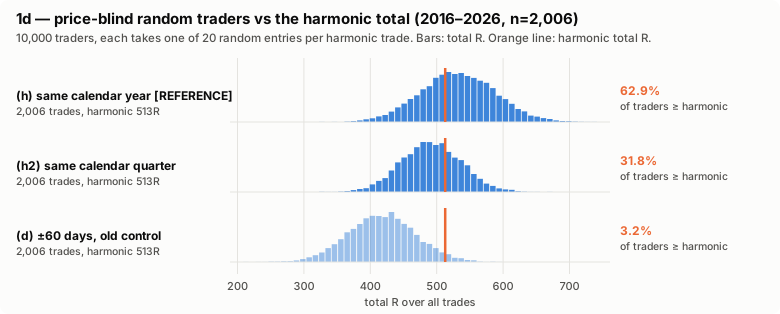
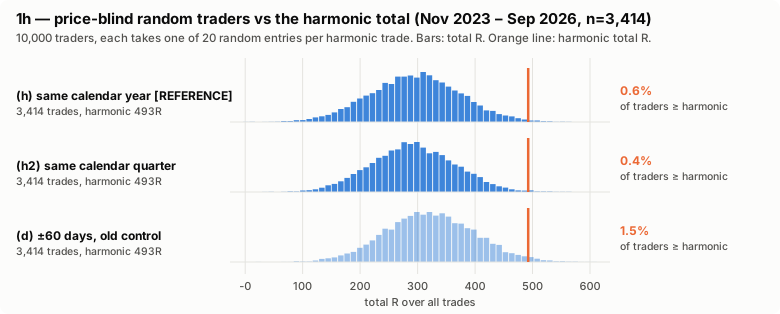
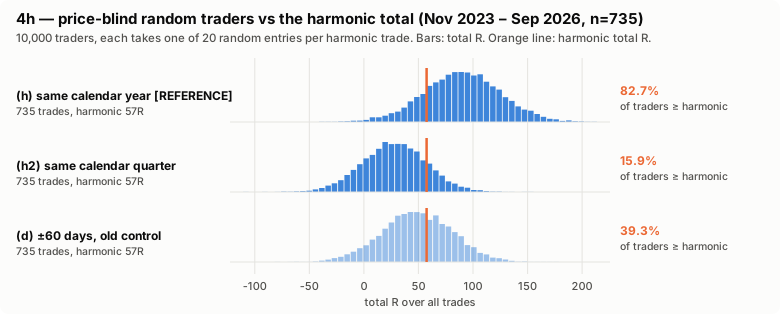
Against a fair, price-blind random entry, daily and 4h harmonic entries are no better than picking any day that year in the same stock: most of their R is the stock's drift. 1h is the exception. It beats random by about 0.06R a trade in both halves and under every control we tried. That is small, but it is the one consistent result.
Explanation checked against the data.
- Hypothesis
- Entering at the harmonic signal beats entering on a random day in the same stock with the same stop % and 2R target.
- Method
- Own re-simulation of logged stop -> 2R, full exit, 20 randoms per trade. Primary control (h): price-blind random entries on the same ticker in the same calendar year (open entry, entry bar counts; see reference-random-control). Sensitivities: (h2) same quarter, (d) +-60 days, (a) original whole-period, (d*) +-60 minus [D, fill], (f) after exit, (g) no-active-pattern days.
- Result
- PRIMARY (h), edge (95% CI) / MC share: 1d -0.01 (-0.07,+0.05) [2016-20 +0.07, 2021-26 -0.07], 63%; 1h +0.06 (+0.01,+0.11) [+0.07 / +0.04], 0.6%; 4h -0.04 (-0.14,+0.05), 83%. Sensitivities 1d / 1h / 4h: (h2) +0.01 / +0.06 / +0.04; (d) +0.05 / +0.05 / +0.01; (a) -0.02 / +0.01 / -0.13; (d*) +0.07 / +0.05 / +0.03; (f) -0.04 / +0.09 / -0.00; (g) -0.06 / +0.02 / -0.09. Paper accounts (1% risk, vs (d) randoms): 1d CAGR 26.1% vs 22.5%; 1h 57.2% vs 17.0%; 4h 7.4% vs 5.2%.
- How much to trust it
- Medium: Python re-sim of TradingView setups with full exits; survivorship universe; the 1h edge holds under every control, while daily and 4h swing around zero depending on the control
- Did it change the live rule?
- parked for the forward-test review (~2027-04); 1h is the only timeframe with a consistent edge
- Notes
- Drift share (random R / harmonic R) under (h): 1d 104%, 1h 60%, 4h 158%. The paper-account comparison still uses the (d) randoms; it was not rebuilt for (h).
Browse every harmonic trade next to its 20 random twins →
Scripts and data for this study will be linked here when the research code is published on GitHub.
Education and research only. Not financial advice. Backtests use today's index members (survivorship bias).