Supported · Entries · 2026-10-11
What should 'random entry' mean? A price-blind reference control
What this means
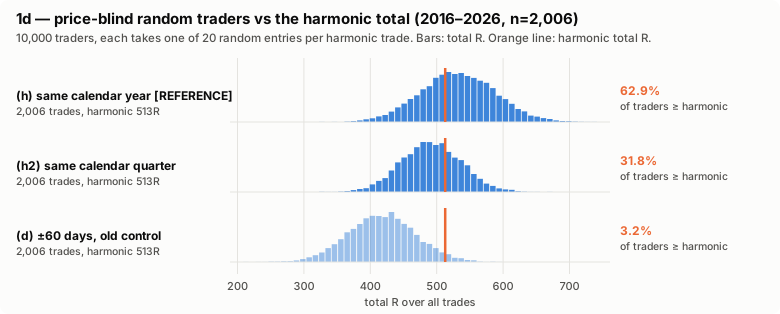
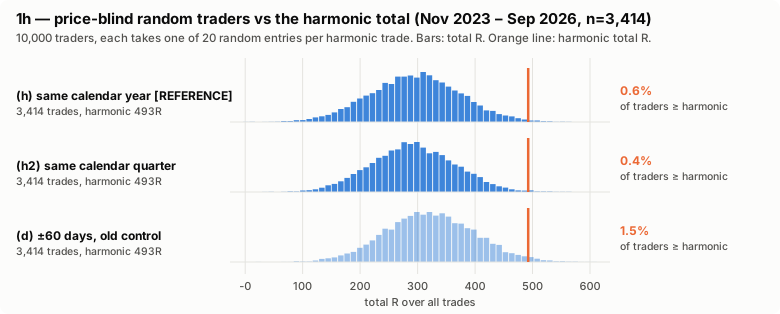
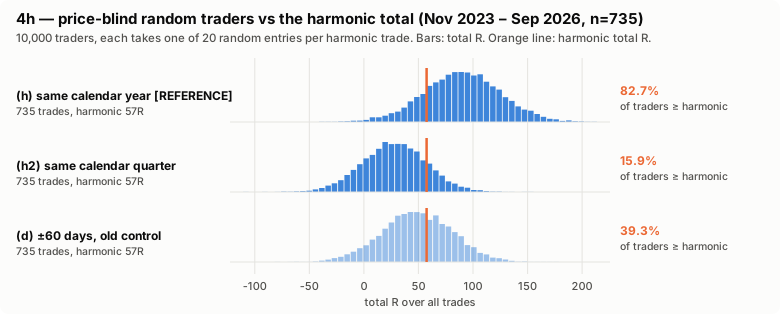
The cleanest question is: if I had bought this stock on any day that year with the same stop and target, would I have done as well? On daily, yes: harmonic entries are no better than a coin-flip day (63% of random traders match them). On 4h, also yes. On 1h, harmonics do beat a coin-flip day by about 0.06R a trade, in both halves, and almost no random trader matches their total. The earlier +0.05 daily edge came from a control centred on dips.
Explanation checked against the data.
- Hypothesis
- A random entry is a fair benchmark only if it picks its day blind to price. Each earlier control leaked price information in a different way, so none measured the harmonic edge cleanly.
- Method
- Control (h): 20 random entries per harmonic trade, same ticker, drawn uniformly from every bar in the same calendar year as the harmonic entry (intraday: same year within the 2023-11 to 2026-09 data). No exclusions. Open entry, entry bar counts, same stop % and 2R target, full exit (build.py sim_many). Sensitivity (h2): same calendar quarter. Ticker-clustered bootstrap CIs, both halves, 10,000-random-trader Monte Carlo. What earlier controls leaked: (a/b) whole decade = market mismatch (randoms from other years and markets; worst on 4h, where trades bunch in 2025-26); (c/d) +-60 days = centred on the signal, so the window holds the decline into D and the bounce just after it; (e/f/g) span-excluded = hindsight (a stretch counts as 'a pattern' only because a decline into D later followed, so excluding spans removes the worst random days).
- Result
- Edge (95% CI) / halves / MC share of random traders >= harmonic total. (h): 1d -0.010 (-0.067,+0.045), +0.07 / -0.07, 63%; 1h +0.058 (+0.011,+0.107), +0.07 / +0.04, 0.6%; 4h -0.044 (-0.140,+0.049), -0.23 / +0.04, 83%. (h2): 1d +0.011 (-0.038,+0.054), 32%; 1h +0.059 (+0.016,+0.102), 0.4%; 4h +0.040 (-0.039,+0.115), 16%. For comparison, (d): 1d +0.047 (3.2%), 1h +0.050 (1.5%), 4h +0.012 (39%).
- How much to trust it
- Medium: Simple, price-blind and reproducible; same-year randoms still share the stock's survivorship drift with the harmonic trades, and a year is a coarse match for the market state
- Did it change the live rule?
- no live change; (h) is now the reference random control for all entry studies, with (h2) and (d) reported as sensitivities
- Notes
- Supersedes (d) as the reference used in entry-vs-random-control-fix and entry-vs-random-pattern-span. Quarter vs year matters most on 4h (-0.04 vs +0.04), where the data is short and trades cluster.
Scripts and data for this study will be linked here when the research code is published on GitHub.
Education and research only. Not financial advice. Backtests use today's index members (survivorship bias).